
Cheapest groupage transport Europe is an important topic for many companies, but in practice, groupage often turns out to be unnecessarily expensive. This is rarely due to the distance or the number of pallets, but mainly due to the way groupage transport in Europe is traditionally organized. Fixed networks, fixed hubs, and fixed routes provide clarity but also lead to extra handling, empty space, and higher costs per shipment.
For trading companies and SME shippers with regular pallet shipments, groupage often feels like a necessary evil: too small for a full truck, yet expensive and not very transparent. Many organizations try to solve this through brokers or fixed LTL carriers, while these structures actually perpetuate the cost problem.
In this article, you will read why groupage transport in Europe is often inefficiently organized, where the hidden costs arise, and how the cheapest groupage transport Europe is not about negotiating harder, but about combining smarter and planning across networks.
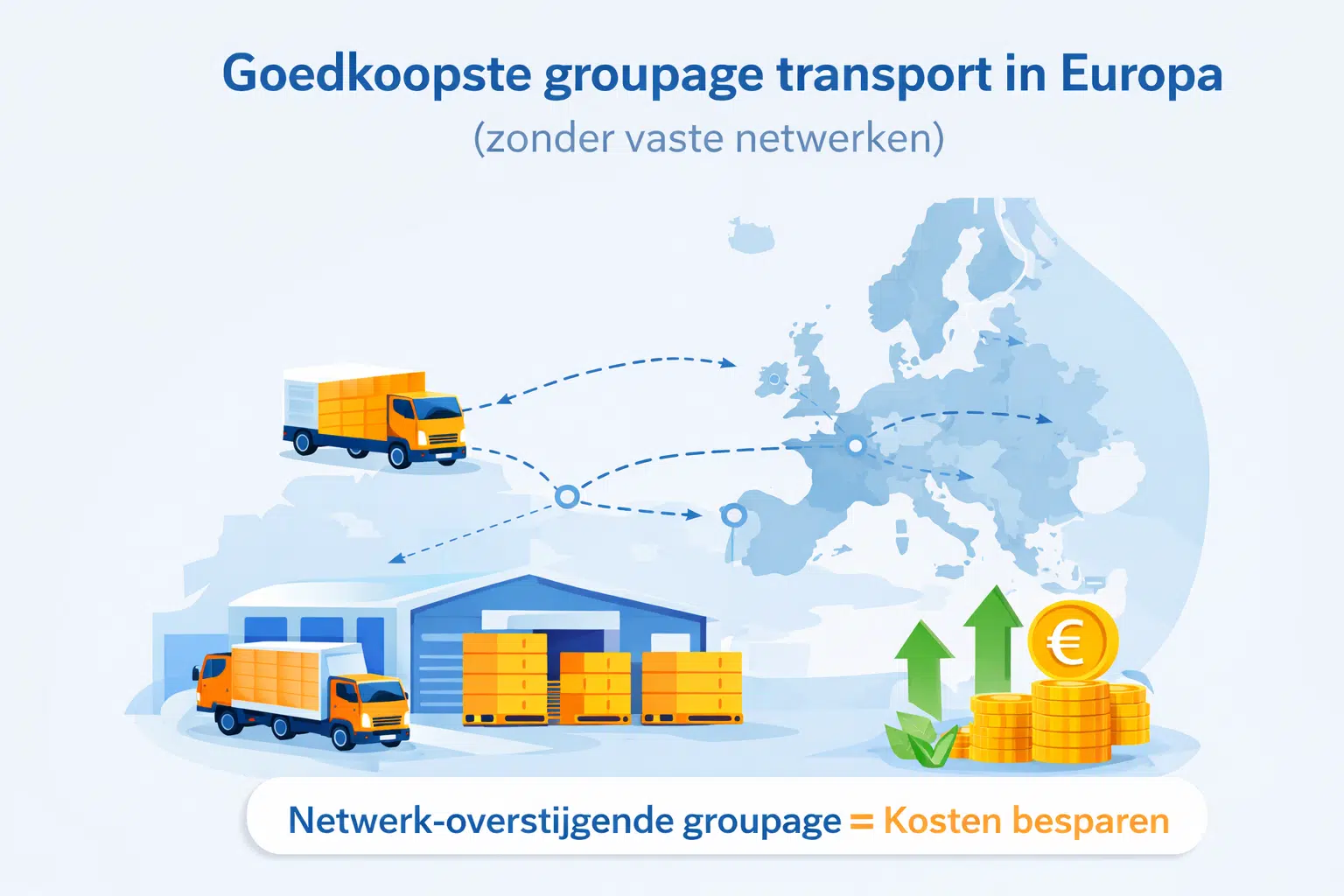
What is groupage transport?
Groupage (LTL – Less Than Truckload) means that multiple shipments from different shippers are combined in one truck. In theory, this lowers costs. In practice, the opposite often happens.
Why? Because most groupage in Europe still works via:
- fixed hubs
- fixed routes (lanes)
- fixed carriers
- fixed margins
That system is clear, but inefficient.
Why traditional groupage is unnecessarily expensive
In classic groupage networks (such as fixed LTL carriers), the process looks like this:
- 1.Pallet pick-up at shipper
- 2.To regional hub
- 3.Transshipment
- 4.To international hub
- 5.Transshipment again
- 6.On to final destination
Each step means:
- extra handling
- extra risk
- extra margin
Moreover, a pallet is often “taken along because it has to be”, not because it fits optimally. Empty space remains.
Why brokers and platforms don’t solve this
Digital transport platforms and brokers seem like a modern alternative. But at the core:
- they still work with one carrier per shipment
- they add a margin themselves
- they optimize per order, not across the network
The result: slightly more convenience, but rarely structurally lower groupage costs.
The Cargors approach: network-exceeding groupage
Cargors approaches groupage fundamentally differently.
Instead of: “Which carrier can drive this shipment?”
Cargors looks at: “Which combinations of shipments, carriers, and routes together result in the lowest costs?”
That means:
- combining across multiple shippers simultaneously
- combining across multiple carriers simultaneously
- no fixed lanes
- no mandatory hubs
Groupage is thus dynamically optimized, instead of statically planned.
Why this leads to lower rates
Network-exceeding bundling creates:
- less empty volume
- less transshipment
- less intermediation
- better loading rate per trip
The price advantage is not a promise, but a logical consequence of the model.
Who is this approach suitable for?
Cargors is especially interesting for:
- SMEs with recurring pallet shipments
- international trade within Europe
- volumes that are too small for FTL
- companies that want control over costs, communication, and transparency
Conclusion
The cheapest groupage transport Europe does not arise from negotiating harder on rates, but from taking a critical look at how groupage is organized today. Many companies accept fixed groupage networks, fixed hubs, and fixed routes as a given, while these structures actually cause extra handling, empty space, and unnecessary costs. In that model, efficiency is subordinate to simplicity, and the shipper ultimately pays the bill.
Anyone who wants to structurally save costs on pallet transport within Europe must look beyond traditional LTL solutions and brokers. By organizing groupage across networks, combining shipments smarter, and not being tied to one carrier or fixed lane, room is created for real optimization. This means less intermediation, a better loading rate, and more control over both costs and execution.
For trading companies and SME shippers with recurring pallet shipments, this difference is essential. The cheapest groupage transport Europe is not a coincidence or a temporary offer, but the result of a different way of planning and combining. Anyone who takes that step will notice that groupage not only becomes more affordable but also more transparent and manageable.
Ready to reduce your freight costs?
Get instant quotes from 500+ verified carriers across Europe.